
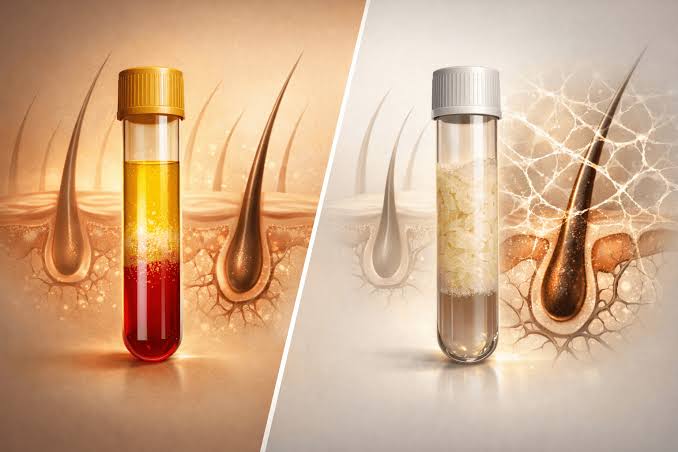
PRP & PRF Treatmentsin EnfieldSkin and Hair Rejuvenation
PRP and PRF use a small sample of your own blood, concentrated to isolate platelets and growth factors, then reintroduced into the skin or scalp to stimulate repair. Nothing synthetic is added, it is your own biology put to work, which is why it appeals to clients who want visible improvement without filler or foreign product.
Uses your own blood, no synthetic product · consultation and honest expectations first
PRP & PRF Treatmentsexplained properly.
What the treatment is, who it suits, when it is needed and why it is worth having done by a clinic that will also handle the follow-up.
What PRP and PRF are
A small blood sample is drawn and spun in a centrifuge to separate and concentrate the platelet-rich portion. PRP is platelet-rich plasma; PRF is platelet-rich fibrin, prepared differently so it forms a fibrin matrix that releases growth factors more gradually. Both are reintroduced into the target area to stimulate the body's own repair processes.
Who it is for
Clients wanting improved skin quality, firmness and radiance rather than added volume, clients treating acne scarring alongside microneedling, and people experiencing hair thinning who want to support scalp health. It suits those who prefer their own biology over injectable products.
When to start
For hair, earlier is better, supporting follicles that are thinning is more realistic than reviving areas that have been bare for years. For skin, whenever quality, firmness or radiance is the concern. Either way, results build across weeks, so start well ahead of any date that matters to you.
Why the assessment matters
PRP is not right for every hair-loss pattern and will not substitute for medical treatment of an underlying cause. We assess the scalp or skin, ask about medical history and medication, and tell you honestly whether the outcome you want is achievable before you commit to a course.
What it costs youto leave it alone.
Leaving hair thinning too long
Follicles that have been dormant for years respond far less than follicles that are still active but weakening. The window for meaningful support narrows the longer thinning goes unaddressed.
Choosing volume when you needed quality
Skin that looks tired because its quality has declined is not improved by adding product. Filler placed in poor-quality skin tends to highlight the texture rather than disguise it.
Expecting a single session to hold
PRP builds cumulatively. One session produces a modest response; a properly spaced course gives the outcome, followed by maintenance. We plan the whole course before starting so the cost and timeline are clear up front.
How we runthis treatment.
Consultation
Skin or scalp assessment, medical history, medication review and an honest discussion of what is realistically achievable.
Blood draw
A small sample is taken under clean conditions at the start of your appointment.
Preparation
The sample is spun in a centrifuge to concentrate the platelet-rich portion while the treatment area is cleansed and prepared.
Treatment
The concentrate is introduced into the skin or scalp, often alongside microneedling for facial treatment.
Aftercare
Simple instructions covering washing, skincare, exercise and sun protection for the following days.
Course & review
Usually three sessions four to six weeks apart, then maintenance, with progress reviewed as collagen and follicle response build.
What you actuallyget out of it.
Improved skin quality
Firmness and radiance improve as the skin's own repair response is stimulated.
Support for thinning hair
Used to support scalp health and existing follicles, with expectations set honestly at consultation.
Nothing synthetic
Your own platelets are used, with no filler or foreign product introduced.
Natural, gradual results
Improvement builds over weeks, so there is no sudden change for other people to notice.
Strong combination with microneedling
Pairing the two is a popular choice for acne scarring and overall facial skin quality.
Short downtime
Mild redness on the day, and most clients carry on as normal afterwards.
What this treatmentis for.
- Improved skin quality, firmness and radiance
- Support for hair thinning and scalp health
- Natural results that build across a course
- Uses your own blood, so no filler or synthetic product
The detail behindprp & prf treatments.
PRP compared with PRF
PRP is prepared at a higher spin speed and delivers a concentrated burst of growth factors. PRF uses a slower spin with no anticoagulant, producing a fibrin scaffold that releases growth factors over a longer period. Which suits you depends on the area, the concern and your consultation findings.
Facial treatment
For the face, PRP is commonly combined with microneedling so the concentrate is delivered through freshly created channels. It is used for overall skin quality, firmness, dullness and acne scarring, and typically runs as a course of three sessions with maintenance afterwards.
Scalp and hair treatment
Scalp treatment targets areas of thinning to support existing follicles. It works best where hair is weakening rather than long gone, and it is often discussed alongside scalp mesotherapy. We are direct at consultation about which patterns of loss are likely to respond.
Course structure and maintenance
A standard course is three sessions spaced four to six weeks apart, with the response assessed over the following months as collagen or follicle activity develops. Maintenance sessions are then spaced at longer intervals to hold the result rather than restart it.
The process
We draw a small sample, spin it to concentrate the platelets, then treat the target area, often alongside microneedling for the face.
What to expect
Mild redness on the day, results building over weeks as collagen responds. A course typically gives the strongest outcome.
Common questions aboutprp & prf treatments.
- Is PRP suitable for hair loss?
- It is commonly used to support thinning hair and scalp health. It works best where follicles are weakening rather than long dormant, and we assess your scalp and set honest expectations at consultation.
- How many sessions will I need?
- Usually three sessions spaced four to six weeks apart, followed by maintenance. Your plan is confirmed at consultation based on the area and concern.
- What does PRP cost?
- Price depends on the area treated and whether it is combined with microneedling. We confirm at consultation before booking: call 07455 249886.
- Does it hurt?
- A small blood draw at the start, then treatment of the area with numbing applied where appropriate. Most clients find it very manageable.
- What is the difference between PRP and PRF?
- PRF is prepared with a slower spin and no anticoagulant, forming a fibrin matrix that releases growth factors more gradually. PRP gives a more concentrated immediate release. We explain which suits your case at consultation.
- How long do results last?
- Improvements built across a course typically hold for months, with maintenance sessions used to sustain them. Skin and hair continue to age, so maintenance rather than a one-off is the realistic model.
- Is there downtime?
- Mild redness on the day, sometimes slight swelling. Most clients return to normal activity immediately, avoiding heavy exercise and sun exposure for the first day or two.
- How soon can I book a consultation?
- Same-day appointments are available for most non-surgical treatments and consultations, subject to the diary. Call 07455 249886.
Put your own biology to work on skin and hair.
A consultation tells you whether PRP or PRF suits your concern and what a realistic course looks like. Call the clinic or send an enquiry to book.
146 Lancaster Rd, Enfield EN2 0JS · Mon–Sat · 10am–7pm · Sunday closed