
Fibrosis Managementin EnfieldAfter Liposuction
Fibrosis is the hard, lumpy or uneven tissue that can form after liposuction. Left alone it can set permanently and hold your contour in the wrong shape. Treated properly it softens, releases and levels out, letting the result you paid for actually show. We treat clients who had surgery with us and clients who had it elsewhere or abroad.
Assessment before treatment · clients treated regardless of where their surgery was performed
Fibrosis Managementexplained properly.
What the treatment is, who it suits, when it is needed and why it is worth having done by a clinic that will also handle the follow-up.
What fibrosis is
After liposuction the body lays down scar tissue as it heals. When that tissue forms unevenly, it creates firm bands, nodules, ridges or dents under the skin. It can feel hard to the touch, look lumpy in certain lights, and cause a tight or pulling sensation when you move.
Who needs treatment
Anyone whose post-operative tissue is not softening on the expected timeline, anyone who can feel firm areas or see indentations, and anyone who had surgery without an aftercare pathway. It is common in clients who had drainage for only a session or two, or none at all.
When to act
As early as you notice it. Early fibrosis responds fastest because the tissue is still remodelling. That said, established fibrosis from surgery months ago frequently still improves significantly, so it is worth an assessment before assuming nothing can be done.
Why hands-on work matters
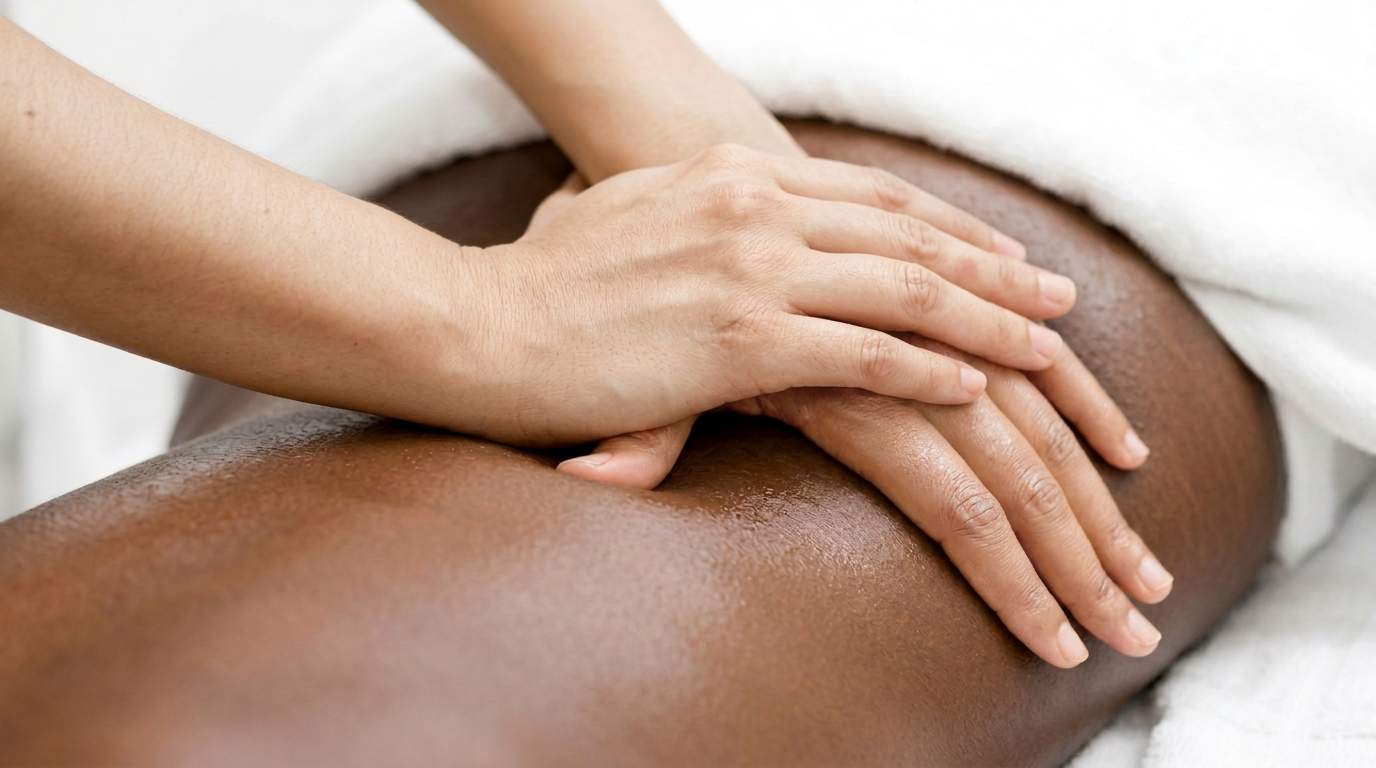
Creams and machines alone rarely release established fibrous tissue. What changes it is sustained, targeted manual work combined with drainage, compression management and consistent self-care between sessions. That requires someone who can map where the tissue has hardened and work it methodically.
What it costs youto leave it alone.
Tissue setting permanently
Fibrous tissue that is never treated can consolidate into a fixed texture. The longer it stays untreated, the more sessions it takes to change, and some very established cases only partially improve.
A contour you did not pay for
Lumps, ridges and dents can make an otherwise successful operation look uneven. Clients often describe being happy with the size change and unhappy with the texture, which is exactly the problem fibrosis creates.
Aggressive self-treatment
Pressing hard into lumps with rollers, gadgets or fists tends to cause bruising and inflammation without releasing anything. Random force is not the same as directional release work, and it can set recovery back.
How we runthis treatment.
Mapping assessment
We examine and map where tissue has hardened, how severe it is and how long it has been there.
Honest prognosis
You are told realistically how much improvement to expect and roughly how many sessions it is likely to take.
Release work
Targeted hands-on work to break down and mobilise fibrous tissue, at a pressure the area tolerates.
Drainage
Lymphatic work follows the release so mobilised fluid and debris are cleared rather than left to re-settle.
Home protocol
Compression guidance, self-massage technique and movement advice to keep progress between appointments.
Review & progression
We reassess the mapped areas across the course and adjust intensity and focus as tissue softens.
What you actuallyget out of it.
Softer, more mobile tissue
Hardened areas gradually release so skin moves naturally over the area again.
A smoother visible contour
Ridges, lumps and dents reduce, so the shape underneath reads evenly.
Relief from tightness
Pulling and restriction ease, which usually improves comfort long before the area looks fully smooth.
Protection of your investment
Fibrosis work is the difference between a good surgical outcome and a good-looking one.
Treatment regardless of surgeon
We take on clients who had procedures at other UK clinics and overseas.
A realistic plan
You are told what improvement is likely and how long it should take, not sold an open-ended course.
What this treatmentis for.
- Softer, more mobile tissue across treated areas
- Fewer visible lumps, ridges and dents
- Relief from tightness and pulling sensations
- A smoother final contour
The detail behindfibrosis management.
Types of fibrosis
Superficial fibrosis sits close to the skin and shows as visible rippling or small hard nodules. Deeper fibrosis forms in bands and feels like firm cords under the surface, often causing a pulling sensation. Each is worked differently, superficial tissue needs finer, more surface-level release, deeper banding needs sustained directional pressure.
Early versus established cases
Tissue in the first weeks after surgery is still remodelling and responds quickly, often within a handful of sessions. Fibrosis six months or more after surgery takes longer and more visits, and improvement is measured in degrees rather than a complete reset. We say which category you are in at assessment.
The role of compression and self-care
A correctly fitted garment supports even healing; a bunched or over-tight garment can create the indentations we then have to treat. Between sessions, hydration, walking and the specific self-massage technique we show you contribute a meaningful share of the outcome.
Working alongside your surgeon
Fibrosis management is aftercare, not a substitute for surgical review. Anything that looks like a seroma, infection or a complication is referred back to your surgeon or GP. Where clients are still under post-operative review, we work within the instructions they have been given.
Assessment
We map where the tissue has hardened and how severe it is, then build a treatment schedule around it. Early fibrosis responds faster, but established fibrosis can still improve significantly.
Treatment
Hands-on release work combined with lymphatic drainage, plus guidance on compression, movement and self-massage between sessions.
Common questions aboutfibrosis management.
- Is it too late if my surgery was months ago?
- Often not. Older fibrosis takes longer and improvement is gradual, but many clients still see a meaningful change. Book an assessment and we will tell you honestly what to expect.
- Can you help if I had surgery elsewhere or abroad?
- Yes. We regularly treat clients whose procedures were carried out at other UK clinics or overseas. Bring any post-operative instructions you were given.
- How many sessions will it take?
- It depends on how established the fibrosis is and how widespread. Early cases respond in a handful of sessions; long-standing fibrosis needs a longer course. You get a realistic number at assessment.
- What does it cost?
- Pricing depends on the size of the area and the number of sessions. We confirm it at assessment before any course is booked: call 07455 249886.
- Does the treatment hurt?
- Firm areas can be tender, particularly at the start. We work at a pressure you can tolerate and intensity usually increases comfortably as the tissue softens.
- Will the fibrosis come back?
- Released tissue does not typically re-harden once healing is complete, provided compression and aftercare are followed through the remaining recovery period.
- How quickly can I start?
- Same-day appointments are available for most non-surgical treatments, subject to the diary. Call 07455 249886 to check today's availability.
- Do you see clients from outside Enfield?
- Yes: Enfield Town, Southgate, Winchmore Hill, Palmers Green, Cockfosters, Edmonton, Potters Bar, Barnet, Chingford and across north London.
Get the tissue assessed before it settles.
An assessment tells you what is treatable, how long it should take and what improvement is realistic. Call the clinic or send an enquiry with your surgery date.
146 Lancaster Rd, Enfield EN2 0JS · Mon–Sat · 10am–7pm · Sunday closed